
 Subscribe
Investigating Nitric Oxide
- Nitric oxide (NO) has a key role in vasodilation, blood pressure, and peripheral diffusion as well as sporting performance. It is thus interesting to me.
- Using test strips, I was able to show an increase in oral nitrites (a precursor to NO production) when using a nitric oxide supplement.
- During the period of supplementation I saw a drop in my average systolic blood pressure of 5 mm Hg.
- I had to abort the study because I realised the peripheral diffusion effect was disrupting my body’s ability to thermoregulate in cold water. I am in the middle of training for a long distance open water swim which involves being in cold water for significant periods of time. I’ll thus re-start the trial once the weather is warmer or after the event.
What is the role of Nitric Oxide in the human body and how do you obtain it?
Nitric oxide (NO) is a key signalling molecule in your cardiovascular health which is produced by the endothelium (the thin lining of your blood vessels). In this capacity its two primary roles are:
- Vasodilation: NO tells the muscles surrounding your arteries to relax, which lowers blood pressure and increases the perfusion of blood to your muscles and organs. This is why people with angina are prescribed a GTN (Glyceryl trinitrate) spray – which provides a rapidly available precursor to nitric oxide for use when they experience chest pains.
- Endothelial health: NO helps to prevent plaque formation (atherosclerosis) and clotting
Nitric oxide is also involved in:
- How efficiently your mitochondria (your cellular power plants) use oxygen to create energy – which could have performance benefits in sport and training.
- Immune defences and wound healing.
- Brain signalling.
- Glucose uptake into muscle cells, independent of insulin.
As nitric oxide is a gas (which is dissolved into your blood and tissues), you don’t take it up directly from either food or respiration but instead create it via two primary pathways:
- Within the lining of your arteries an enzyme converts amino acids (L-Arginine and L-Citrulline) into nitric oxide. L-Arginine is obtained from protein sources and (if you are taking one) is probably included in your protein supplement. L-Citrulline is almost certainly not in your protein supplement and is rarer in your diet (watermelon being a source) and is more likely to come from a specific supplement.
- When you eat nitrate-rich food, good bacteria on your tongue (your oral microbiome) convert nitrate (NO3) into nitrite (NO2) which you swallow. Nitrite is then converted into nitric oxide during digestion and in your muscles. Nitrate-rich foods include: rocket (arugula), beetroot, celery, spinach, bok choy, and swiss chard. Given the role of your oral microbiome in that second pathway, it is also worth giving some thought to promoting the health of your oral microbiome. For example, oral mouthwashes have been shown to kill good bacteria (as well as bad) in your mouth. Thus, an oral hygiene routine based around flossing, avoiding sugar, and a gut healthy toothpaste may be beneficial.
It is important not to be confused by the health risks associated with the nitrates and nitrites used as preservative in processed meats (like bacon and sausage) and the benefit of nitrates from plants. The difference is that when preserved meats are cooked the nitrates/nitrites react with amines (from the protein in the meat) to form nitrosamines. It is these nitrosamines that are associated with increased cancer risk and not the underlying nitrates/nitrites.
Why am I interested in Nitric oxide?
There are a number of reasons that nitric oxide caught my attention when doing some reading:
- NO production declines with age whilst cardiovascular risk rises.
- As an aid to sports and training performance.
- As part of my ongoing strategy to ‘work around’ the cardiovascular risk of my genetically high Lp(a) levels.
- I have for some years had an intermittent issue in the tips of a couple of my toes which the doctor has wondered might be a blood supply / perfusion issue.
How can you get a measure of your current levels and what supplement did I trial?
Given that nitric oxide is a gas with a short lifespan, the accurate way to measure nitric oxide levels in a lab would be a gas chromatograph – which you are not going to be doing at home. However, you can buy oral test strips which use the level of nitrites in your saliva as a proxy. Whilst these are not going to provide an absolute measure, they should provide a trend measure – i.e. they would be useful in seeing whether a particular supplement or food did boost your nitric oxide pathways. In my trial I used Berkeley Life’s NO test strips
After some research the supplement I used was Transparent Labs Nitric Oxide
What did I observe?
I used the test strips before taking the supplement, whilst taking it and after. Prior to the supplement, the grading for nitrites in my saliva was ‘very low’. Once I started the supplement, it rose over 12 hours to ‘Target’ and stayed there whilst I took the supplement. On ceasing, it dropped over about 24hrs back down to very low:
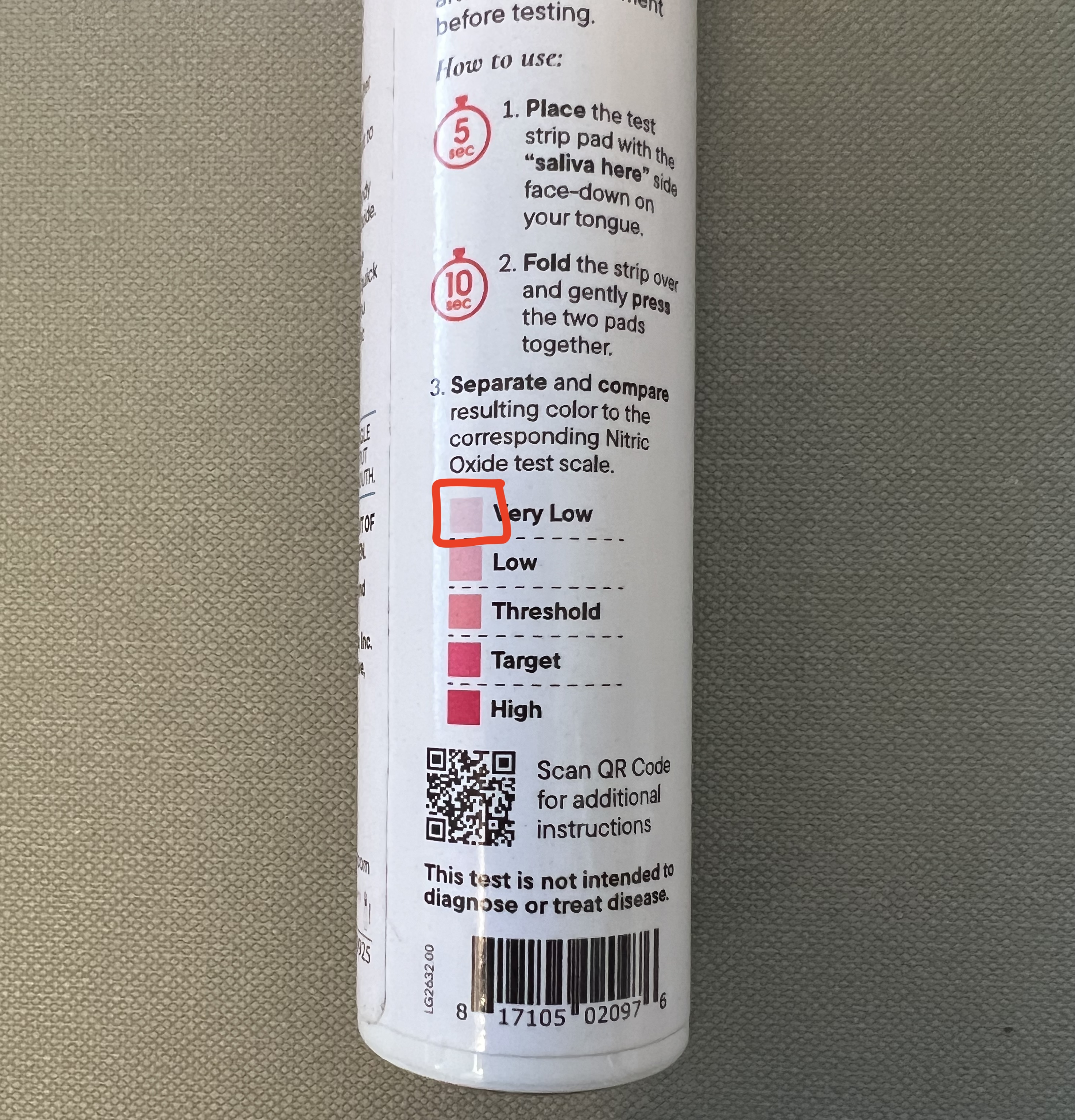
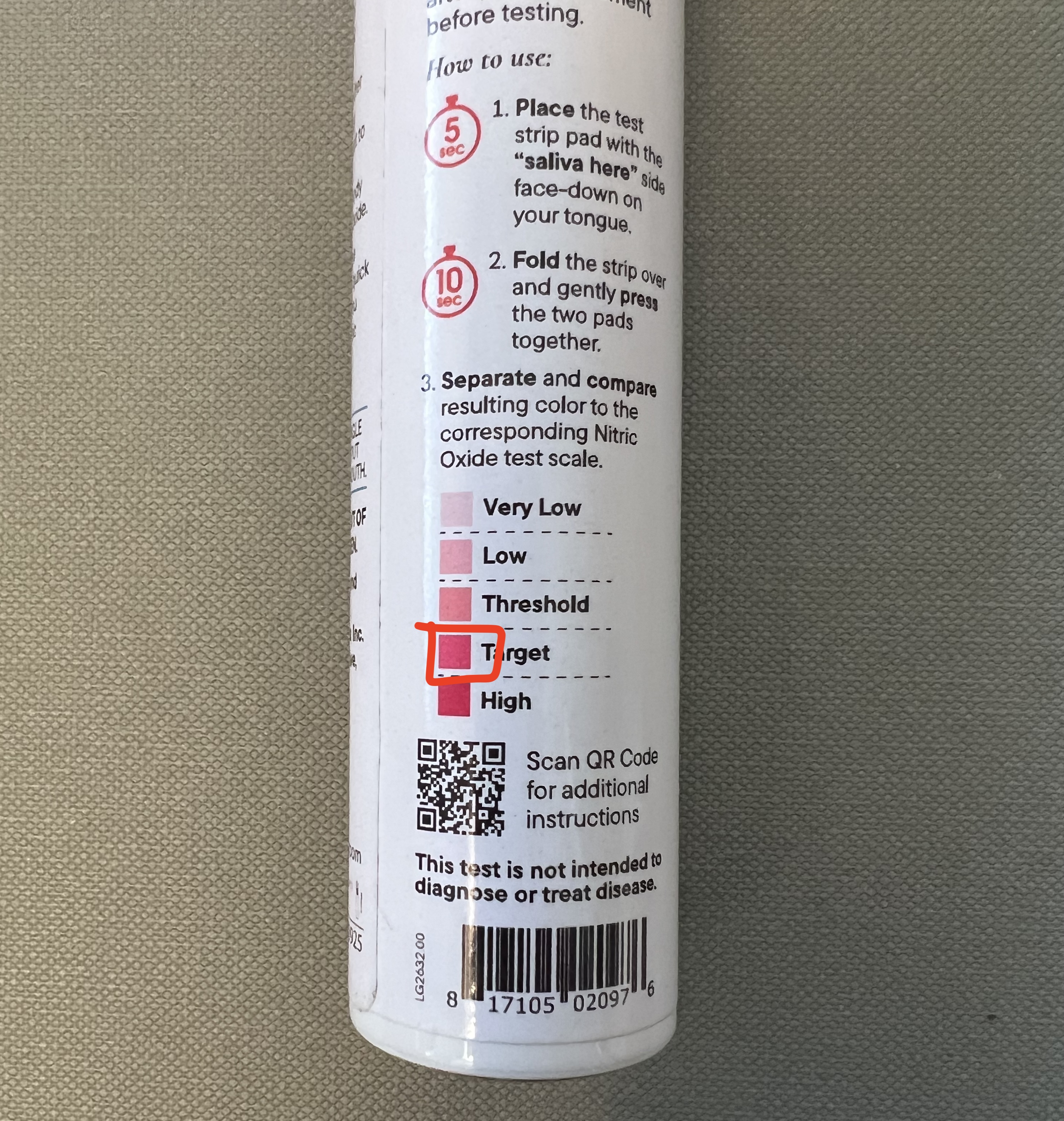
It seems fair to assert that the supplement does lead to an observable increase in nitrites and an inferred increase in NO production.
In the period I was taking the supplement, I recorded a drop in my average systolic blood pressure of around 5 mm Hg (down to 113 from a normal average of 118).
However, I hit a (with hindsight obvious) issue that caused me to temporarily stop supplementing. I am training for a ‘marathon’ distance open water swim of 5 miles – which has involved carrying on swimming through the winter to stay acclimatised. On my first long swim after starting the supplement, I was noticeably (dramatically!) colder and bailed with safety concerns at half my usual distance. What I suspect is that the increased NO levels were (as expected) causing vasodilation and increased peripheral diffusion. I was basically jamming my peripheral blood supply open at the same time as it would want to contract and pull blood away from the surface and into my core. In effect, I turned off part of my body’s ability to thermoregulate in cold water. Once the weather is warmer again and beyond that event, I’ll drop back into supplementing again and resume the study. But, for now, that’s not an effect I want. I suspect the subtle solution is to stop supplementing 24–36 hrs in advance of a cold water swim.