
 Subscribe
An exploration of fats prompted by my confusion over whether frying with Extra Virgin Olive Oil creates trans fats
- As Extra Virgin Olive Oil (EVOO) is high in monounsaturates, it has good stability under heat and is OK to fry in and, of course, it comes with the benefit of being a good source of antioxidant polyphenols.
- Avoid anything with partially hydrogenated fats (i.e. trans fats) on the label. These are generally agreed to be dangerous for human health and are banned in many countries (or being phased out).
- Avoid anything that could have been cooked in polyunsaturates or could contain cooked polyunsaturates. This is because oxidised/rancid polyunsaturates (caused by their lack of stability under heat) attack cell membranes and red blood cells and cause damage to DNA. In addition, the heating process could have generated trans fats.
- However, polyunsaturates presented naturally in their ‘cold’ form (e.g. in nuts and high-quality cold-pressed seed oils) are fine and have a positive effect on LDL. Consume them naturally as part of a real food diet.
- Be very clear in your mind that just because one oil has a higher smoke point than another, that does not mean it is necessarily more chemically stable under heat.
What caused my concern?
So I got two (at face value) different messages from two separate books. Compare this from ‘Metabolical’ by Dr Robert Lustig…
“Yes, you heard that right. Trans-fats are very low in Real Food, but you can make them right on your stove from any unsaturated fat. In fact, you can turn one of the healthiest fats in your kitchen (olive oil) into the deadliest (trans-fat) with just extra heat. The reason? Unsaturated fats have cis-double bonds (see Fig. 7-3c). If you heat an unsaturated fat past its smoking point, that cis-double bond can isomerize (flip) into a trans-double bond, and voilà—a trans-fat (see Fig. 7-3b).”
…with this from ‘Food for Life’ by Dr Tim Spector
“The less saturated fat and the more polyunsaturated fatty acids (PUFA) an oil contains, the more easily it will break up into other molecules, as seen with many vegetable oils. These multiple compounds are of unknown health risk and also potentially damaging to food texture, aroma and taste. High-quality olive oil is one of the more stable oils as it contains plenty of saturated fats. This is another reason that a good Extra Virgin Olive Oil is my cooking oil of choice, with high-quality rapeseed as a backup.”
So the first is saying that olive oil, whilst being very healthy, is high in unsaturated fats which create trans fats when heated beyond their smoke point. The second is saying that olive oil contains plenty of saturated fats which makes it stable and OK to fry in! Both agree fully that cold (extra virgin) olive oil is heart-healthy, a great source of antioxidant-rich polyphenols, and an excellent addition to the human diet when used cold in dressings and drizzled over food. Where they disagree is on whether I should be frying using something else!
What is the difference between olive oil and Extra Virgin Olive Oil?
- Extra Virgin Olive Oil: This is the highest grade, the first press, and is mechanically extracted without heat or solvents. It is rich in antioxidant polyphenols and has the best taste.
- Virgin olive oil: Is a grade below, still mechanically extracted, still a high-quality food, but does not have the rigorous purity and flavour of the extra virgin oil.
- Olive oil (or pure olive oil): This is primarily refined olive oil (which has been treated with heat and filtration), is targeted for cooking since the removal of particles will lead to a higher smoke point. However, that same refinement process removes the polyphenol health benefits of Extra Virgin Olive Oil. It may have a small amount of virgin olive oil added back in for flavour.
Anywhere that I write olive oil in this entry, you can take it to mean extra virgin as I only buy that and use it both for frying and for dressing/drizzling. When not talking about Extra Virgin Olive Oil I use the phrase ‘refined olive oil’ to be clear.
What are the different types of fats?
There are four key terms we need to get clear, but first a quick recap on what (from a chemistry perspective) a fat is:
Fats (lipids) are a class of organic substances (those where carbon provides the key structural framework) that are not soluble in water. Most fat in our bodies and in the food we eat is in the form of triglycerides, that is, three fatty-acid chains attached to a glycerol molecule. In simple terms, fatty acids are chains of carbon atoms with hydrogen atoms filling the available bonds.
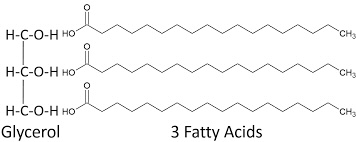
The difference between “saturated” and “unsaturated” depends entirely on what those three fatty acid chains look like at a molecular level.
- Saturated fatty acids: In these, every available spot on the carbon chain is occupied with a hydrogen atom (i.e. there are no double bonds between any of the carbon atoms). They are highly stable which means that they do not normally go rancid, even when heated for cooking purposes. Because they are straight in form and hence pack together easily, they are solid or semisolid at room temperature (e.g butter, coconut oil). The liver can make these from carbohydrate.
- Monounsaturated fatty acids: In these almost every available spot on the carbon chain is occupied with a hydrogen atom, but there is one double bond between two of the carbon atoms. This single double bond introduces a kink which makes them less straight than the saturated fatty acids, so they tend to be liquid at room temperature. They are relatively stable but are a bit more sensitive to light and heat than saturated fats. The monounsaturated fatty acid most commonly found in our food is oleic acid (which is the main component of olive oil as well as the oils from avocado and various nuts). The human body can make these from saturated fatty acids.
- Polyunsaturated fatty acids: In these there are multiple double bonds between carbon atoms. They are thus highly unstable (reactive) and very sensitive to light and heat, making them go rancid easily. The two polyunsaturated fatty acids found most frequently in our foods are double unsaturated linoleic acid, with two double bonds (more familiarly called Omega-6) and triple unsaturated linolenic acid, with three double bonds (Omega-3). We cannot manufacture these and must get them from our diet. Generally, nowadays the introduction of polyunsaturated fats from seed oils (like sunflower, soyabean and canola) means omega 6 has come to dominate over omega 3 in our diets – with Omega6 being more pro-inflammatory and Omega-3 more anti-inflammatory.
- Trans fats: Most natural unsaturated fats (like those in olive oil) are in a “cis” configuration where the hydrogen atoms are on the same side of the carbon double bond. This causes (as discussed above) a kink in the molecule which makes them liquid and more reactive (less stable) than saturated fats. In trans fats the hydrogen atoms are on the opposite side of the double bond which removes the kink and makes them behave more like a saturated fat. Whilst these do occur to a small amount in nature – what we are concerned about is industrial trans fats (look at for the phrase partially hydrogenated fats on ingredient labels) created by bubbling hydrogen atoms through vegetable oil to make it stable and increase its shelf life. Trans fats have been shown to be bad for human health and are banned or being replaced in many countries [3].
With that clarity on types of fats, the following notes are also useful (although not directly related to the topic of frying in olive oil):
-
Why is a high triclyceride level in a lipid panel a bad thing?: If ’triglyceride’ is a generic term for various fatty acids, whatever their impact heart health - why is there a concern when a lipid panel shows high triglycerides? This is not because it’s a measure of ‘something bad in your blood’ – it’s because it’s an indicator of metabolic issues. High triglycerides are often the first sign that your liver and muscles are “full” (insulin resistant). When your body can’t store sugar as glycogen any more, the liver turns that sugar into fat (triglycerides) and dumps it into the blood see Big 10 #4 for more details.
-
There is a general sense in the public that saturated fats are bad for heart health – is this valid?: The reason the medical establishment focuses on saturated fat is because saturated fats can make the liver less likely to pull LDL out of your blood. This causes LDL particles to circulate for longer. Even though the saturated fat molecule itself is stable, the resulting high concentration of LDL particles in your blood increases the statistical probability that some will eventually crash into your artery walls. While polyunsaturated fats are chemically less stable under heat, when eaten in their natural, unoxidised state (like in walnuts, flaxseeds, or cold-pressed oils), they actually upregulate those same LDL receptors. Thus, they lower blood LDL levels. This is why clinical trials (like Mediterranean diet studies) often show heart health benefits when people swap saturated fats for unsaturated ones. Polyunsaturated fats in their raw form (e.g. nuts and seeds) are heart healthy, but when heated, they can be dangerous due to the reactive nature of rancid/oxidised fats or due to the creation of trans fats. In fact, some saturated fats are needed for human health, but they are a biological necessity rather than essential (like vitamin C) because the liver can manufacture some of them from carbohydrate. It’s OK to ingest a moderate amount of saturated fat via healthy real food sources. For example, Kefir and 100% dark chocolate in my case along with the saturated fat component of Extra Virgin Olive Oil.
Specifically, what fats are in olive oil?
While the exact percentages can fluctuate slightly based on the olive variety and the climate, the trade standard [1] profile for Extra Virgin Olive Oil is:
| Fat Category | Percentage Range | Primary Fatty Acid |
|---|---|---|
| Monounsaturated (MUFA) | 73% – 83% | Oleic Acid |
| Saturated (SFA) | 13% – 14% | Palmitic Acid |
| Polyunsaturated (PUFA) | 8% – 9% | Linoleic Acid |
So, is olive oil safe to fry in?
As olive oil is only 8%-9% polyunsaturated, it is primarily monounsaturated fat with some saturated fat, and thus we can expect it to show good stability under heat. Research consistently shows that home frying temperatures (typically 180°C / 350°F) are nowhere near intense enough to cause the chemical “cis-to-trans” flip in olive oil. For example, in a landmark study published in the International Journal of Fats and Oils, researchers fried potatoes in olive oil at 180°C (356°F) for 15 minutes. Even after reusing the same oil 8 times, the level of trans fats generated was less than 0.002% [2].
So I disagree with the quote from Dr Robert Lustig because he has classified olive oil as being ‘unsaturated’ without the more accurate classification of being high in monounsaturated fat and low in polyunsaturated fat. With that correction, extra virgin olive oil will behave more like a saturated fat and show good stability under heat.
I agree with the quote from Dr Phil Spector. However, where he states “High-quality olive oil is one of the more stable oils as it contains plenty of saturated fats”, this should be more accurately written as: “as it contains plenty of monounsaturated fats”.
Why not fry in refined olive oil and reserve the more expensive Extra Virgin Olive Oil for dressing and drizzling?
Given that both have the same mixture of fats in them and that refined olive oil is cheaper and has a higher smoke point, it might seem, at face value, that a smart move would be to use the refined type for frying and the extra virgin for cold dressing and drizzling (given its superior taste).
However, despite its lower smoke point, extra virgin shows greater stability under heat (which is critical to reduce oxidisation of the fats) because:
- It has not been previously treated with heat (as is the case for refined olive oil).
- The presence of the particles left behind (those carrying the polyphenol benefits) confers a ‘sacrificial’ benefit, taking the heat and oxygen first ahead of the fats.
- In addition, refined olive oil often already contains a small amount of trans fat created during the refinement process.
If all one cared about was cost, then, yes, it would make more sense to fry with the refined olive oil. But if you are looking for health protection due to stability under heat, then it’s better to use extra virgin. It’s important not to assume that just because an oil has a higher smoke point, it is more stable chemically.
So, what about rapeseed oil?
Another alternative would be to fry with refined rapeseed oil (or it’s variant - canola) as it is cheaper and has a high smoke point - and reserve Extra Virgin Olive Oil for use cold as a high quality, healthy ingredient.
Again, we have to be clear on what grade we are talking about. Rapeseed can be found as:
- Cold pressed: A higher-cost, high-quality product which is a bit like the extra virgin grade of olive oil. Like Extra Virgin Olive Oil, this contains polyphenols (different ones) but at lower concentrations that Extra Virgin Olive Oil.
- Refined: This has been refined under heat and has the particles removed to increase its smoke point, making it cook hotter without smoking.
The fat percentages of rapeseed oil are:
| Fat Category | Percentage Range | Primary Fatty Acid |
|---|---|---|
| Monounsaturated (MUFA) | 63% | Oleic Acid |
| Saturated (SFA) | 7% | Palmitic Acid and Stearic acid |
| Polyunsaturated (PUFA) | 28% | Linoleic Acid |
Rapeseed oil is thus higher than olive oil in terms of polyunsaturated fats and lower in saturated fats and monounsaturated fats, which would make it less stable under heat than olive oil.
So if you had to choose between frying in cold-pressed rapeseed oil or frying in Extra Virgin Olive Oil, you should choose olive oil as it is more stable under heat. However, if cost is a strong factor then it is worth noting that cold-pressed rapeseed oil can be as much as 50% cheaper than Extra Virgin Olive Oil.
When used cold, rapeseed oil’s higher polyunsaturated fat levels confer even greater heart benefit than olive oil but with a reduced payload of antioxidant polyphenols.
However, using refined rapeseed oil for frying falls to exactly the same issue as frying with refined olive oil discussed earlier. Despite its higher smoke point it is less chemically stable under heat than it’s cold-pressed variant.
So what’s the sweet spot between cold-pressed rapeseed and Extra Virgin Olive Oil?
Assuming achieving the lowest cost is not your only driver (probably fair given that you are reading an article focussed on health 😉) you can forget frying in the refined variety of either.
- If health matters but cost is a factor too: Fry in cold-pressed rapeseed oil and use Extra Virgin Olive Oil for dressing/drizzling
- If health matter more than anything: Fry in Extra Virgin Olive Oil and also use it for dressing/drizzling
Further reading
A discussion on cooking with olive oil on healthline.com
A useful summary of the basic chemistry of fats
Refences
[1] International Olive Council. (2022). Designations and definitions of olive oils. Trade Standard Applying to Olive Oils and Olive-Pomace Oils. COI/T.15/NC No 3.
[2] Albi T, et al. Stability of edible oils and fats to pan-frying. Grasas y Aceites. 1997;48(1):8-13.
[3] World Health Organization. Drafting and implementing a tax on sugar-sweetened beverages: a guide for policy-makers. Geneva: World Health Organization; 2018. (Note: For the specific trans fat mandate, use:) World Health Organization. REPLACE trans fat: an action package to eliminate industrially-produced trans-fatty acids. Geneva: World Health Organization; 2018.