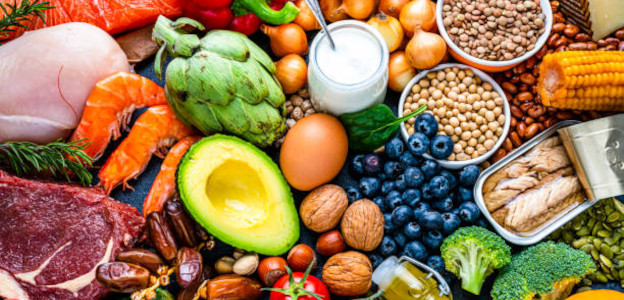

Eat Healthily, Consider Using Time Restricted Eating, and Prioritise Building a Strong Gut Microbiome
Don't worry about particular diets or restrictions (unless they are for personal moral reasons). Instead, focus on eating real food and avoiding processed foods and refined sugars. If suitable for you, time-restricted eating can be an effective way to manage your insulin levels and control your weight. Feed the trillions of good bacteria living inside you so that they can nourish and protect you.
Want to look at the science later but, right now, you are just interested in some actions to take?
Why should you focus more on eating real food than on any particular diet?
TBC
Why could you consider time restricted eating and even fasting?
The essence of time-restricted eating is to eat roughly the same amount of calories as you do normally but to reduce the window of time in the day when they are consumed (and to avoid snacking between meals).
- You are a medicated diabetic
- You are pregnant or breastfeeding
- You have a history of eating disorders
- You are underweight
- You are a child
There are many patterns to follow, so you can experiment with what works for you. For example, you could skip breakfast, eat lunch around midday and dinner around 6pm. You are thus only eating for around 6hrs of the day and fasting for 18hrs of the day (which is referred to as an 18:6 split).
Rather than launching straight in with something like an 18:6 split, you might want to build up slowly by starting with perhaps a 12 hr feeding window and reducing that over time. Although there are all sorts of patterns and ratios you could use, try to avoid eating close to your bedtime, leaving at least 3 hrs if not more between your last meal and sleep. You can read more about eating and sleep in Big 10 #3.
What are the benefits of time-restricted eating?
- Metabolic health: Throughout your fasting period you are avoiding elevating your blood glucose (and thus insulin), which can help to combat high-insulin levels, inflammation, and protect against type 2 diabetes. You can read more about blood glucose monitoring and insulin in Big 10 #1
- Visceral fat reduction: Visceral fat is the ‘hidden’ fat that builds up around your organs and is particularly dangerous when it comes to inflammation and metabolic health. In your fasting period your body will draw down on this visceral fat and, over time, help to reduce it to a healthier level. You can read more about visceral fat in Big 10 #6
- Weight loss: Although you are not attempting to restrict your calories, a natural function of restricting the feeding window is that it can be hard to consume the same amount you always did. In addition, eating real foods which are high in fibre, good fats and protein (and low in refined sugar) will help you feel fuller and experience more even blood sugar levels. Both of these will also help with weight loss over time, and you may well find that time-restricted eating is less uncomfortable (and more sustainable in the long term) than calorie restriction.
- Achieving ketosis: Straight after your last meal your body is in a fed state, insulin levels are elevated, and your cells are burning glucose. As you move deeper into your fasting window, blood glucose levels begin to drop and your pancreas will signal to your liver (via the hormone glucagon) to break down stored glycogen to release more glucose. Towards the end of the fasting period (around 16 hours, but this can vary hugely person to person and depending on what your last meal was), all the ’easy’ sugar is gone, and the body flips to breaking down stored fats (lipolysis). The brain cannot use these free fatty acids (the product of lipolysis) as fuel as they cannot cross the blood-brain barrier – so the liver converts them into ketone bodies. Unlike fat, these ketone bodies (e.g Beta-hydroxybutyrate - often abbreviated to BHB) can cross the blood-brain barrier and are a very efficient source of energy. Some people report feeling more alert and focussed when in ketosis, and this (along with metabolic stability, reduced inflammation and possibly even longevity and cell renewal) is one of the benefits that advocates of a ketogenic diet espouse. Some people find a ketogenic diet hard to stick to in the long term, and time-restricted eating can be a way to ‘dip your toes’ into ketosis daily. If you are interested in finding out if you are actually achieving ketosis towards the end of your fasting window, you might like to use a blood ketone monitor such as Keto Mojo or even a continuous ketone monitor like SiBio. Ignore the urine test strips as they are generally not accurate and are more of a gimmick. To be honest, on a 16-hour or 18-hour fasting window you may not get into ketosis (or if you do, not to a significant level or not for very long) and, if this interests you, then you might want to intermittently add in a longer fasting window.
Fasting for longer periods of time
If time-restricted eating works well for you and you feel well on it, then you could also try adding in occasional longer fasts (e.g. a 48 hr fast once a fortnight). A longer fast will intensify the benefits listed above, and you are much more likely to achieve a high level of ketosis.
As for the time-restricted eating, work up to this slowly both in terms of the duration of your fasts and how often you do them. It is also important to stay well-hydrated when fasting as the drop in insulin levels will trigger your kidneys to stop holding onto salt, which will take with it a significant amount of water. Excessive plain water drinking on a longer fast has the potential to lead to low sodium levels, so you might to add a pinch of salt or an electrolyte tablet that contains salt to some of your drinks over the fast.
Remember, humans have been practising fasting for religious reasons for thousands of years, and we evolved in an environment where access to food was often intermittent and unpredictable. Although our modern conditioning to eat regularly and snack often makes fasting feel ’extreme’, provided fasting is suitable for you (see above) it is a perfectly normal activity for your body. Most people’s bodies have significant fuel reserves in the form of fat, and the shift to ketosis will power your brain and body from those reserves very well. It is also worth noting that your feelings of hunger will not remain constant over the fast (tending to come in waves or at intervals) and will decrease or stop as your body enters ketosis.
What are the additional benefits of longer fasts?
Autophagy
Why should you care about your gut microbiome?
Further sources of information
A great source of information on time-restricted eating and fasting is Dr Jason Fung, and a couple of his books are listed in ‘Further Source of Information’ at the end.
https://www.youtube.com/watch?v=CpEbEqp-5FE