
Monitor Your Body Composition with Specialist Scanning
Use DEXA scans to measure your visceral fat, lean muscle mass, and bone density so that you can reduce the risk of metabolic disease and increase your healthspan.
Body composition scanning provides key information on the levels of visceral fat you are carrying (which is a significant contributor to metabolic disease). These scans also provide an accurate measurement of your lean muscle mass, which is a key marker for longevity.
Want to look at the science later but, right now, you are just interested in some actions to take?
What is a DEXA Scan?
There are two main uses of this scan:
- To measure your body fat and overall body composition. It is significantly more accurate, detailed, and useful than the body mass (BMI) score (which cannot tell the difference between muscle and fat) [1]. If you are beginning (or following) a weight loss or fitness programme, it provides a great baseline view and allows you to track and monitor your progress in terms of reducing body fat and increasing your lean muscle mass.
- The second use is to measure your bone mineral density (BMD)and see how dense (or strong) your bones are. This is used to help assess your chances of osteoporosis (a condition where bones become weak or brittle, increasing the risk of fractures) and osteopenia (where your bone mineral density is assessed as lower than normal but not yet at the level for a diagnosis of osteoporosis).
Why should you care about DEXA scans?
Visceral fat: This fat (the ‘hidden’ fat laid down around your internal organs) is of particular concern due to its role in inflammation, insulin resistance, cardiovascular health, and other conditions [2]. Such conditions have a huge long-term impact on the chances of the long and healthy life you seek. A DEXA scan will give you a specific measure for visceral fat and allow you to put in place strategies to tackle it, such as time-restricted eating and fasting, in combination with dietary changes.
Lean muscle mass: A DEXA scan can provide early warning where your lean muscle mass is below the normal, which is an indicator for sarcopenia (the age-related progressive loss of muscle mass, strength, and function). To live a long, healthy, and active life, you need to maintain as much muscle function as possible and keep the rate of that inevitable loss as low as possible [3]. Getting an understanding of your muscle mass (overall and broken down by limbs and torso) lets you put in place strategies (such as resistance training and dietary protein) to fight the age-related loss of muscle.
Bone density: Similarly to the point on muscle mass above, the ability to get early insight into your bone density and to track reductions in it enables you to put in place strategies to slow this. Such strategies could include resistance training and dietary changes to include sources or supplements rich in calcium and vitamin D.
How much does a DEXA scan cost?
In the UK you may qualify for a bone density scan free of charge, but body composition scans are generally not available for free. For a combined package of bone density plus body composition along with a consulation and report you would expect to pay privately around £250 (convert this…).
I booked mine through BodyView and was very satisfied with the service, the consulation, and the report provided. But, of course, you should have a look around as a number of providers are available.
What did I learn from my DEXA scan?
I’m very happy to share my report so you can have a detailed look at what you might expect to receive following on from your own consultation.
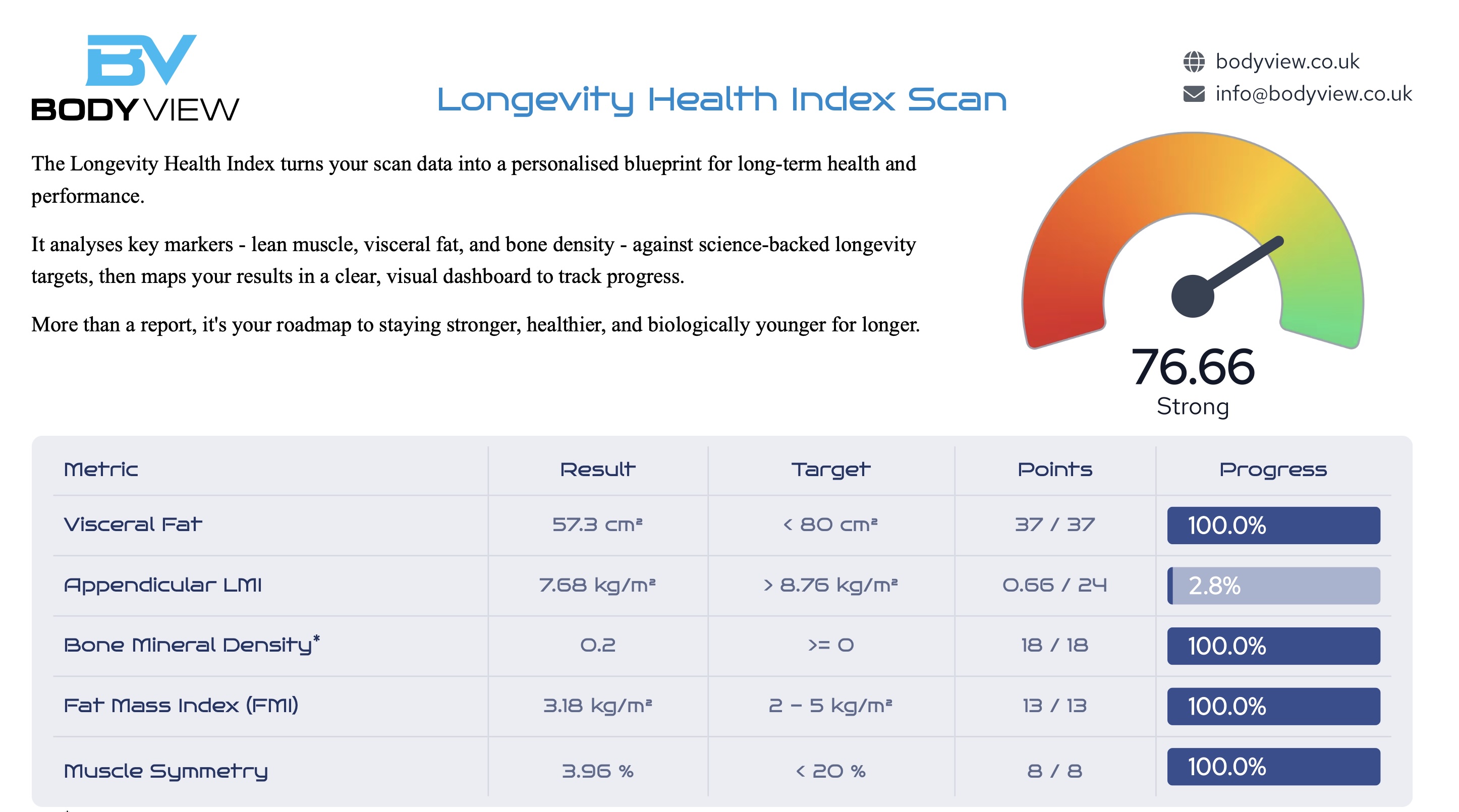
I gained an invaluable insight from my recent DEXA scan. In short, although my measures for body fat percentage, visceral fat, and bone density were good, my lean mass was below average. The specific distribution of my lean mass showed a normal distribution for my arms, below average for my trunk and way below average for my legs.
This feels consistent with insufficient and irregular strength training coupled with my preference for using swimming to get my cardio workout (and using specific additional land-based swim training for my shoulders). This has probably helped to keep the arms and shoulders close to normal but allowed my legs to languish. A couple of extenuating factors here could be:
- My use of time restricted eating on the day of the scan leading to a lower amount of water stored in muscles (when you fast, your body needs to buffer less salt and dumps water) – but at best this would account for maybe 0.5-1Kg of lean mass
- My preference for low-weight, high-rep strength sessions in the gym focussed on endurance as opposed to high-weight, low-rep workouts (focussed on muscle growth).
This result is a risk for longer term problems related to insufficient muscle mass and function and has led to me re-evaluate my weekly training regime to:
- Increase the overall amount of resistance training within my schedule
- Temporarily bias the number of leg workouts over upper body workouts
- Shift the number of reps downwards and the load higher
I’ll then rescan in 6 months and see what improvements I can make. Finally, in summary, here is my Longevity Health Index Result:
Further sources of information
The Examine web site for independent, unsponsored meta-analyses of health research
Outlive: The Science and Art of Longevity by Pete Attia MD
Forever Strong by Dr Gabrielle Lyon
References
[1] NICE (National Institute for Health and Care Excellence), Clinical Guideline [CG189]: Obesity: identification, assessment and management
[2] Ross, R., et al. (2020). “Waist circumference as a vital sign in clinical practice: a Consensus Statement from the IAS and ICCR Working Group on Visceral Obesity.” Nature Reviews Endocrinology.
[3] Cruz-Jentoft, A. J., et al. (2019). “Sarcopenia: revised European consensus on definition and diagnosis.” Age and Ageing.