
 Subscribe
An exploration of why my Appendicular Lean Mass Index (ALMI) is lower than expected
- My training (and sports) has always tended more to cardiovascular rather than raw strength/power (climbing, mountaineering, running, swimming)
- My resistance training has not been as consistent in the past as it should have been (often absent in favour of getting outdoors!)
- My resistance training in recent times has been focused more on low weight, high rep endurance. As the reply below states: “Endurance athletes often have smaller muscle cross-sectional areas but very high mitochondrial density and efficiency. In other words, the muscle works extremely well, but there isn’t a large volume of it”
- In conclusion, my ALMI is for sure NOT as good as it should be, but probably not as bleak as it appears in the report
- Some months back after getting the report I added an extra legs workout in and have shifted my whole programme to higher weights, lower reps. To be fair, I can already see/feel a difference, and it actually seems to be helping my swimming. Hopefully I’ll get a slightly better result when I am scanned again!
What is Appendicular Lean Mass Index (ALMI)?
You can read more about ALMI in:
- Big10 #2 - ‘Exercise Regularly and Include both Resistance and Cardiovascular Workouts’
- Big10 #6 - ‘Monitor Your Body Composition with Specialist Scanning’
In summary, ALMI is the lean mass on just your limbs but adjusted for your height and is a key indicator of longevity and avoiding sarcopenia and frailty with age.
What was my concern?
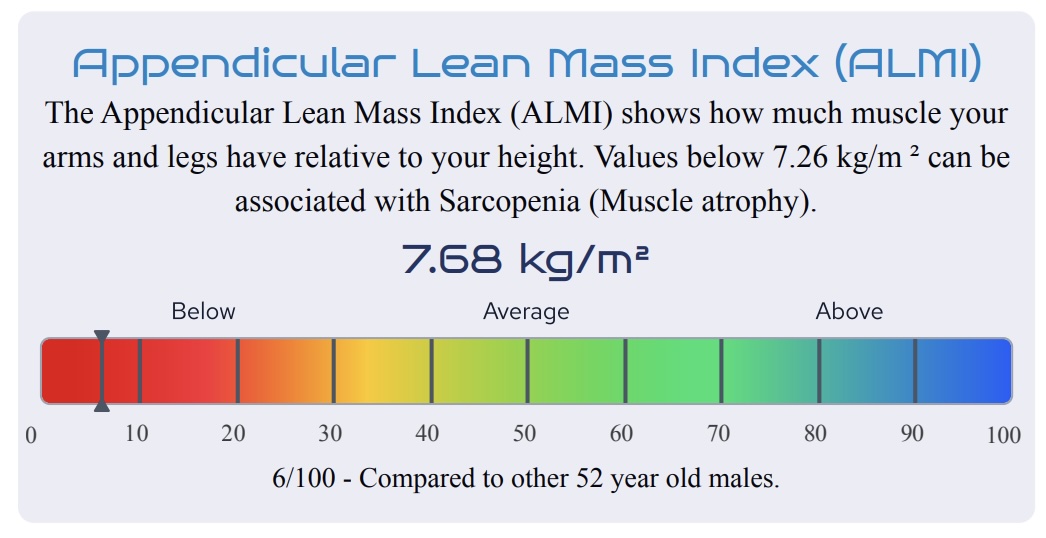
My ALMI was very low (placing me in the bottom 6% of men my age and height). Given that…
- I have a solid resistance training programme
- In recent times I have completed a half-Iron Man triathlon
- I can run a 10k in just over 50 mins
- I can swim 4k open water in 1 hr and 30 mins
- I seem fitter, stronger and in better condition than my peer group and friends
…I was struggling to see how I would end up assessed in the bottom 6% of men my age and height. Had I come in the middle of the curve I would have taken that as a push to get some extra resistance training in - but this was so low I felt the need to dig into the topic deeper.
What did I discover?
I had some speculative ideas around:
- Has my focus (due to my sports) on endurance (mountaineering, swimming, running, hiking, etc) led to me having a different profile which throws off the test?
- I am very ‘skinny/wiry’ rather than ‘big/bulky’ perhaps ALMI accommodates height but not body frame?
I contacted my scan consultant with the following message after I had had time to digest my report at home:
“I was surprised at how low my ALMI came out. Whilst I probably could indeed do a bit more in the gym and do agree my arms/chest are more developed (I’m a long-distance outdoors swimmer) than my legs, it seems very unlikely that in terms of physical capability I would be in the bottom 6/100 of 52-year-old men my height. For context, I did a half-Iron Man the year before, can comfortably swim 4k outdoors, can run 10K in 52 mins and do at least 1 solid legs day a week in the gym. Out of my peer friend group, I’m probably the fittest and most active. So, zero issue with boosting resistance training, and this is a kick to do more. But I’d like to understand if there are subtleties to ALMI that I should be bearing in mind for my next scan that could be making this seem ‘worse than it is’. For example:
I have a slender/wiry build (think endurance runner rather than powerlifter).
My resistance training to date has been higher reps at lower weights to focus on endurance rather than bulk/power.
I use time-restricted eating (but not calorie restriction) and would have been fasted for around 13 hours at the time of scan.
What I’m thinking is that this could be more about the kind of muscles I have developed rather than how I stack up against the general population of 52-year-old, 6-foot men? Said that I fully understand the longevity value of a high score in this area and will be tweaking my approach to resistance training. Just interested in understanding the methodology in more detail, and your input is much appreciated.”
Their reply was as follows:
Thank you for raising that concern, I hope my email explains this well and can help you adjust your training for the next 6 months.
It can seem confusing to be lean, athletic and high performing, yet score low for appendicular lean mass. The key point is that being lean and having lower muscle mass are not opposites. Being Lean refers to having a low body fat rather than a lot of muscle.
You weigh 69.7 kg, with 56.5 kg of lean mass. This essentially shows that you carry relatively little body fat, which is consistent with your endurance training and physique. However, ALMI specifically looks at how much muscle mass is in your arms and legs relative to your height. Your score of 7.68 kg/m² places you at the 6th percentile for men your age purely in terms of the quantity of muscle within your arms and legs. This does not mean you are weak or lack performance capacity. It simply means you do not carry a large amount of muscle tissue in your limbs compared to other men your age.
It’s important to separate cardiovascular fitness from muscle mass. Your half Ironman, 4 km swims and 10 km run time are strong indicators of aerobic fitness and endurance. These adaptations come from a highly efficient cardiovascular system not necessarily from having large muscles. Endurance athletes often have smaller muscle cross-sectional areas but very high mitochondrial density and efficiency. In other words, the muscle works extremely well, but there isn’t a large volume of it.
Many men in the comparison population may carry more absolute muscle mass simply because they are heavier or have trained more for strength or hypertrophy. That does not automatically make them fitter, it just means they have more tissue. So you can absolutely be lean, high performing and relatively low in appendicular muscle mass at the same time. Those things are not contradictory.
As your resistance work has been focused on higher reps with lighter loads, it’s been more specific to muscular endurance rather than muscle growth. Endurance style training improves stamina and efficiency in the muscles, but it doesn’t provide the optimal stimulus for increasing the amount of muscle mass in the limbs. Training with moderate weights in the 6–12 rep range with progressive overload tends to be more effective for hypertrophy (building muscle size) than high-rep, low load work.
To encourage increases in muscle mass in your arms and legs, you could consider:
Shifting more of your resistance training toward moderate loads and rep ranges: 6–12 reps rather than consistently very high reps, as this provides a stronger hypertrophic signal.
Progressive overload- gradually increasing the weight, reps, or number of sets over time. This is the key driver of muscle growth.
Focusing on compound movements (squats, deadlifts, presses, rows) that recruit larger muscle groups and stimulate growth. Make sure the safety of performing these movements are a priority first to avoid injury.
Training each major muscle group more than once per week, which research suggests supports hypertrophy more than very infrequent sessions
It is also worth noting that as we get older, the body’s ability to build muscle becomes less efficient. After about age 50, the process that creates new muscle proteins (which is needed for growth) doesn’t respond as strongly to training and protein intake as it does in younger adults. This is a well described age‑related effect known as anabolic resistance. Essentially, your muscles need a slightly stronger stimulus (heavier or progressively increasing loads and consistent protein intake) to drive growth compared to when we were younger. What this means in practical terms is that muscle increases tend to be slower and require a more targeted approach to training and recovery as we age, even for very active individuals
I hope that clarifies things more clearly
What I took from this:
I was wondering if my theory that my slender body frame meant I would get a lower ALMI than broader men of my age and height. So I ran the following thought experiment:
ALMI is calculated on height and not surface area/body frame. To check my understanding, I ran the following calculation:
The formula for ALMI is lean mass (kg)/height(m) to the power of 2. In my case that would be: 25.34 kg/(1.816 * 1.816 ) = 7.68 kg/m2. Which is the same as my scan report – which confirms my understanding.
So two men of the same age and height will have their total lean mass (i.e. muscles, tendons, bones etc) divided by the same value. Taking the following thought experiment:
- Bob is 52 years old, just under 6 foot, is broad with wide shoulders and pelvis/hips.
- John is 52 years old, just under 6 foot, is wiry with narrow shoulders and pelvis/hips.
Irrespective of their training and fitness and lifestyle (how lean they are). Would it be true to say that Bob is going to get a bump on lean mass because of his broader frame and thus also additional tissue and muscle just from having a ‘wider’ frame and carrying it? Both Bob and John will have their different lean mass scores divided by the same value, and Bob will get a better ALMI score.
There is a flaw in my logic, though. Since ALMI specifically excludes the trunk and only looks at the limbs, it is not so easily fooled by body frame. The broader framed guy is going to get a slight bump because likely the bones in his arms and legs are naturally wider/thicker and with more muscle volume just to function – but probably it is not hugely significant.
The points in the reply are both valid and useful, and this quote is particularly useful:
“Endurance athletes often have smaller muscle cross-sectional areas but very high mitochondrial density and efficiency. In other words, the muscle works extremely well, but there isn’t a large volume of it”
So I think really it is: the kind of sports I have done, in conjunction with my spotty approach to resistance training in the past, and a more recent focus on endurance resistance work, and maybe a small hit from my slender frame that comes up with such a low number. I reckon I actually have pretty strong leg and arm muscles – but there just isn’t a big volume of muscle. With that said, I want to see a higher number here next time I am scanned, so I am sticking to a solid resistance training programme at higher weight with lower reps.