 Subscribe
Exercise Regularly and Include both Resistance and Cardiovascular Workouts
Commit to a structured, consistent, regular programme of exercise that includes resistance training as well as cardiovascular and flexibility/stability work. Use a wearable and/or sports watch and apps to track your progress.
Why should you care about exercise?
Exercise is not just a good habit; it is, along with sleep and nutrition, a critical pillar of your well-being affecting almost all aspects of your mind and body. Exercise is also an essential consideration when thinking about your health span (not just living longer, but living well as you age).
Want to look at the science later but, right now, you are just interested in some actions to take?
I classify the benefits of exercise into two top-level categories:
‘Hard’: Your muscles, bones and metabolism
‘Soft’: Your brain, sleep, wellbeing and social connection
‘Hard’ benefits
- Cardiorespiratory: Exercise strengthens your heart and lungs, ensuring your body is supplied with the oxygen needed to perform.
- Bone density and muscle mass: Heavy loading strengthens your bones and muscles, protecting against fractures and weakness as you age but also ensuring a healthy and active life.
- Glucose disposal: Muscle is the primary site for clearing sugar from your blood. Having greater muscle mass and exercising helps to control your blood sugar and protect against type 2 diabetes.
- Immune system: Muscle is a storage site for amino acids which your body can use to fuel your immune system when fighting illness.
- Hormonal: Exercise supports healthy levels of key hormones.
‘Soft’ benefits
- Neurological: Exercise triggers the release of Brain-Derived Neurotrophic Factor (BDNF) which has powerful benefits for your brain.
- Sleep: Regular physical exertion improves sleep quality.
- Emotional Resilience: Exercise helps to regulate cortisol and reduce stress.
- Social connection: Whether it’s a running club, a yoga class, or a tennis match, exercise will bring you together with other people and make you feel great in the process.
- Self-confidence: The more you do hard things, the more you believe you can and the better you feel about yourself.
Exercise is a vast topic. However, I believe, to simplify it a bit, there are two key measures that you can easily obtain for yourself. If you base your exercise routine around improving them (ideally with the help of a coach or personal trainer for at least some of your sessions), you can’t go far wrong. So, what are they?
Exercise metrics for longevity
Whatever sports watch, wearables, and apps you use, they’ll be collecting a ton of data and generating all sorts of metrics and progression graphs and charts. Whilst being able to track your progress is inherently valuable and rewarding, there are two specific measures that stand out above the others when we are thinking about longevity and healthspan. If you know these scores for yourself and are working to progress them, then you are going in the right direction, whatever your specific exercise and sport preferences are:
VO2 Max
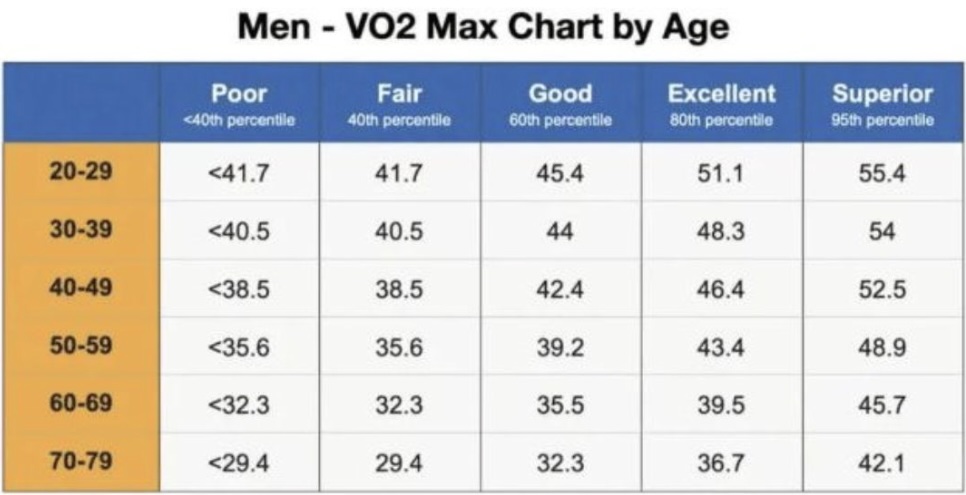
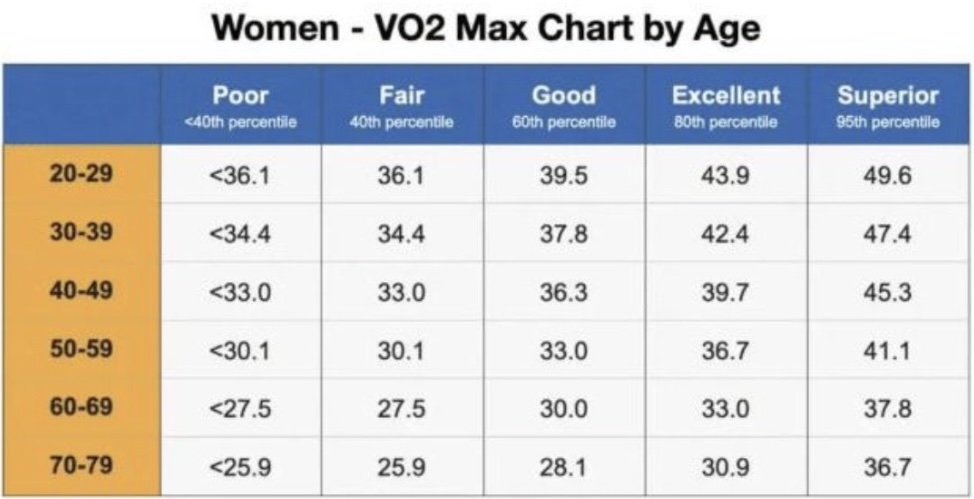
Technically speaking, VO2 Max is a measure of the maximum amount of oxygen your body can use during intense exercise. Effectively, it represents how well your lungs take in oxygen, how well your heart pumps that oxygenated blood, and how efficiently your muscles use that oxygen to create energy. VO2 Max is measured in milliliters of oxygen used per kilogram of body weight per minute (mL/kg/min) and is highly dependent on age, gender, and fitness.
VO2 Max is more strongly associated with a longer life than almost any other health metric, including not smoking or having healthy blood pressure[2]. Your sports watch and/or wearable will be attempting to measure and track your VO2 Max, but the most reliable way to get an accurate reading is to be tested. This is a non-invasive but uncomfortable test which involves running on a treadmill (or using a stationary bike) whilst wearing a mask that both delivers oxygen and measures your waste gases. The treadmill will get steeper and faster until you are at your limit and/or when the technician can see your body has reached its maximum oxygen uptake capacity. Your sports watch/wearable will also give you an estimate of VO2 Max, but there is no substitute for getting an accurate reading and then providing that measure to your device as a benchmark since devices are good at spotting change/progress but less good at getting an absolute measure.
Depending on your age, gender, and level of fitness, the value will be somewhere on the following tables. Your target should be to get it as high as you can and certainly to be (ultimately) well above the average for your age. The following charts are for the general population rather than for trained athletes:
I get my VO2 Max testing done at the same facility ( BodyView) that does my DEXA scans. See (Big10 #6 - ‘Monitor Your Body Composition with Specialist Scanning’) and below, for more information on DEXA scans.
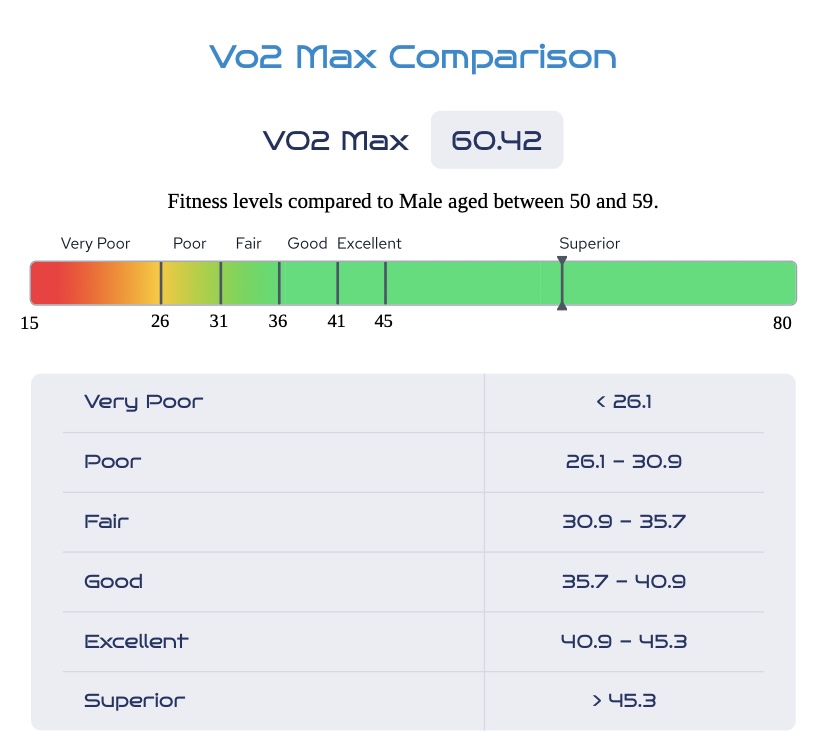
I’m very happy to share my last VO2Max test results so you can have a detailed look at what you might expect to receive following on from your own consultation. My last result was as follows:
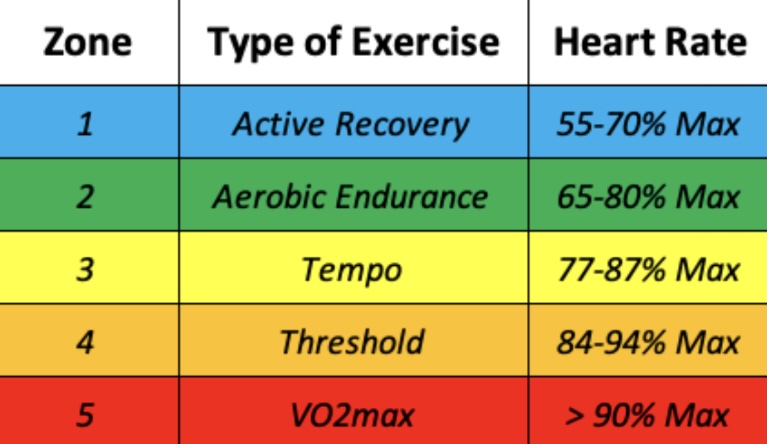
To improve your VO2 Max, you are looking at cardiovascular work (running, cycling, swimming, etc.) but you need to be getting into Zones 4 and 5 (see below). High Intensity Interval Training (HIIT) is perfect for this as its stop/start nature will give you more time at your limit than you could manage in a continuous block.
Lean muscle mass:
There are actually several measures in this area which are interesting, and all of them can be gathered from a DEXA scan See (Big10 #6 - ‘Monitor Your Body Composition with Specialist Scanning’):
- Lean Mass: This is your total mass minus your fat mass and gives a number for the mass of your muscles, bones, organs, etc.
- Lean mass Percentage: This is the same as your Lean Mass but expressed as a percentage of your total body weight.
- Lean Mass Index: This is your lean mass but adjusted for your height (if you are taller, then your lean mass will be more spread out, if you are shorter, then it is more packed in).
- Appendicular Lean Mass: This is the lean mass on just your limbs (i.e. excluding your torso). This is calculated separately as it is a more specifically useful measure when it comes to longevity since it targets the areas most crucial for mobility and physical function.
- Appendicular Lean Mass Index (ALMI): This is the lean mass on just your limbs but adjusted for your height.
The single most useful one of these measures for our purposes is your ALMI. Your target (much like VO2 Max) is to get yourself well above the average for your age and gender. Low values (especially later on in life) are associated with sarcopenia (muscle atrophy) so you, of course, want to aim for the opposite of that. The report that will be prepared for you by the consultant performing your DEXA scan will place you on that distribution for your gender and age bracket so you can see where you are at.
A word of caution on bathroom scales. There are a number of smart scales on the market that will claim to be able to tell you your lean mass, but even the best (which can approach the cost of DEXA scan in price) don’t have the accuracy and reliability of a DEXA scan.
To improve your ALMI, the two primary factors to consider are:
- Your protein intake: Many people don’t get enough protein, and this becomes even more important as you load your muscles with resistance training. A good daily protein target (for the average population rather than elite athletes or body builders) is 1.6 g per kg of body weight [3]. So for a 70 Kg person, they’d be looking at around 112 g of protein per day. Aim to get as much of this from high-quality foods (which will vary, of course, depending on whether you eat meat or are vegetarian or vegan) but expect also to supplement with a protein shake of some description to hit your target. For athletes and body builders you would be looking at a target of up to 2.2 g per Kg body weight. There is more information on protein and supplements in Big 10 #5: ‘Design Your Personal Supplement Stack Informed by Blood Testing’
- Your resistance training programme: To increase your muscle mass, your resistance training is going to focus on lower repetitions at a higher load to cause significant hypertrophy (muscle micro-tears followed by repair and growth). This is where using a personal trainer can be very helpful to design you the right kind of programme.
Like VO2 Max, ALMI is strongly associated with a longer life span [4] so it is essential to know your score and adjust your diet and training programme to improve it.
My personal programme
There is an almost infinite amount of health guidance and coaching available when it comes to exercise, to the extent that it can be a real challenge working out what the best thing to do is, and somehow fitting that into a busy work and family schedule. However, if useful, below you can see at a high level the programme that I follow. It works for me as it gives me good coverage across resistance training, flexibility, and cardio, whilst also including elements that contribute to positive well-being. I can also fit this into around 90 minutes, doing something each day of the week with my yoga sessions acting as a lighter recovery day, interspersed between heavier resistance and cardio workouts.
Resistance training: As discussed earlier, my view is that this is a non-negotiable part of any exercise programme aimed at longevity and health. I’m using a mixture of free and machine weights at my local gym. To be honest, I’d always prefer to be exercising outdoors, but I appreciate and am grateful for the long-term benefits that I believe resistance training will give me. I’m currently prioritising two leg sessions vs. one upper body session a week since my swimming also gives me a strong upper body workout. I’m also doing an extra legs session since my last DEXA scan showed an imbalance between legs and upper body in terms of lean mass. If you are new to resistance training, I’d strongly suggest starting with a coach or personal trainer to get a good programme worked out and to ensure you are using a good form. Be sure also to read my post on supplements for information on protein, creatine and other exercise-related supplements.
Cardiovascular (swimming): You have so many options here for what you could swap into your schedule. I’ve been a middle and long distance runner all my life and love running (but I’m not sure it loves me). In recent years, I’ve switched over to long-distance swimming as being potentially (for me) less injury-prone. I also love the mental well-being I get from swimming in cold and open water, and this has preserved the outdoors aspect that I loved in running. Another benefit from the open water swimming that I’m hoping to get is some vascular ‘work out’ from the effects of handling the cold (especially as I still swim outdoors once a week, even in the winter months). Hopefully this complements the similar benefit obtained from my hot yoga classes. During my swim sessions I’m mixing in some higher intensity zone 4/5 work as well as the more endurance focussed zone 2-3 training since (as noted earlier) there are some very specific benefits from bursts of high intensity.
Cardiovascular (Norwegian 4x4): Norwegian 4x4s are a High Intensity Interval Training (HIIT) protocol aimed at boosting VO2 Max and achieving heart remodelling. The protocol is the result of a study conducted by researchers at the Norwegian University of Science and Technology (NTNU)[1]. The protocol is pretty straightforward, warm up and then do four mins of zone 4/5 exercise followed by three mins total rest and then repeat four times before warming down. This gives you 16 mins of intensity in a 25-minute block. I try to dial in two of these a week (generally tacking them onto my resistance sessions so I can use cardio machines at the gym). To keep it fun, I vary these between elliptical, rowing machine, static bike, and SkiErg machine. I included this in my programme because as mentioned earlier, VO2 max is a “gold standard” measure when it comes to longevity. It is a system-wide stress test that doesn’t just measure your lungs; it measures the harmony between your heart, blood vessels, and mitochondria (energy production). A direct, inverse relationship between cardiorespiratory fitness (VO2 Max) and all-cause mortality has been established in a large scale study [2].
Flexibility (yoga): I love yoga (it has to be Ashtanga for me but there are many options) as it delivers a triple hit of flexibility, light resistance load, and balance whilst also throwing in a whole load of breath work, mindfulness and a lovely group/class community vibe. I use a hot class because I’m hoping (see my post on hot and cold) for some vascular benefits to complement the similar effect from my cold water swimming. I also find the heat helps me to feel more supple in the postures and makes it feel more of a workout also. There are some great apps for Yoga (e.g. Down Dog) but I would always suggest that a class with an expert practitioner leading it is going to lead to better and safer results. Poor form in Yoga is just as capable of causing damage as other forms of exercise.
Cardiovascular (hiking): This is a great way for me to give my step count a boost, along with getting all the mental wellbeing and sunlight benefits of being outdoors, and getting a good zone 1/2 workout AND spending time with my partner. I try and get a short (30 mins) walk around the middle of the day (when work permits) and a longer (10 K or so) hike at the weekends. This, however, is the ‘bonus’ in my programme and the other elements have to take priority.
Social/wellbeing (climbing): For me this is primarily about mental well-being and spending time with friends than it is about pushing my strength and cardio fitness. There is so much positive stuff in climbing whether it’s the clarity of mind that comes from focussing on the route, managing fear, the commitment between climbing partners to keep each other safe, even just being outdoors.
Wearables: I use Whoop for tracking my strain, recovery and sleep and find it very beneficial in terms of feedback and thinking about how hard to push in any given session. I’m also a big fan of gamification in exercise and enjoy the sense of accomplishment of hitting my weekly commitments and long-term streaks. I’m still also using my older model Garmin Fenix Watch for a couple of specific reasons – it’s brilliant for tracking laps in the pool and, unlike Whoop, has GPS built in so for hiking (and running, of course) that probably gives better data than the phone geolocation capability that Whoop uses and means I can leave the phone behind (when safe to do so). Whereas I feel the sensor on the Whoop is much better than my (older) Garmin and is my go-to for vitals, recovery and sleep tracking. I also think the AI coach is better in Whoop than in Strava - but that could well just be personal preference. Although of course both devices overlap in their capabilities, for me (at least in 2026 anyway) it’s not an either or choice – both are valuable and have their place in my programme.
Apps: There are a huge number of sports performance and tracking apps out there, and different Apps will suit different sports better (for example, you might want a different app for resistance training as opposed to cardio). I use Strava which both my Whoop and Garmin sync to. I like the long-term trend views of fitness Strava gives but, perhaps more than anything, I like the social and slightly competitive aspect of it with friends and family. I don’t use social media at all since I (personal bias alert) view it as an algorithm-driven devil of dopamine hits, time-wasting, sleep disrupting, anxiety inducting noise - but I do love a bit of a scroll on Strava so I can see what people are up to and share my own training. I also use Apple Health as the underlying repository for all my data (being fed by my wearables, weight tracking, blood pressure, blood sugar monitor and so on)
| Type | Exercise | How Often | Duration |
|---|---|---|---|
| Resistance Training | Legs | Twice a week | 90-minute sessions including warm up and cool down |
| Resistance Training | Upper body | Once a week | 90-minute session including warm up and cool down |
| Flexibility and wellbeing | Hot yoga class | Twice a week | 60-minute sessions |
| Cardiovascular and wellbeing | Open water swim | Once a week in the winter, twice a week in spring, summer and autumn | 30-120 minutes depending on the season |
| Cardiovascular | Pool swim | Once a week in the winter | 60-minute session |
| Cardiovascular | High Intensity Interval Training (Norwegian 4x4s) | Twice a week | 25 minutes each time |
| Cardiovascular and wellbeing | Hiking | Ad-hoc | 120–240 minutes |
| Social connection and wellbeing | Climbing | Ad-hoc | 120 minutes |
Further sources of information
The Examine website for independent, unsponsored meta-analyses of health research
Outlive: The Science and Art of Longevity by Pete Attia MD
Forever Strong by Dr Gabrielle Lyon
Lifespan by Dr David Sinclair
References
[1] Helgerud, J., et al. (2007). “Aerobic High-Intensity Intervals Improve $VO_2\text{ max}$ More Than Moderate Training.” Medicine & Science in Sports & Exercise.
[2] Mandsager, K., et al. (2018). “Association of Cardiorespiratory Fitness with Long-term Mortality Among Adults Undergoing Exercise Treadmill Testing.” JAMA Network Open.
[3] Morton RW, et al. A systematic review, meta-analysis and meta-regression of the effect of protein supplementation on resistance training-induced gains in muscle mass and strength in healthy adults. British Journal of Sports Medicine. 2018;52(6):376-384.
[4] Srikanthan P, Karlamangla AS. Muscle mass index as a predictor of longevity in older adults. The American Journal of Medicine. 2014;127(6):547-553.